
Why Trezor and Ledger Apps Are Different From Traditional Crypto Wallet Apps
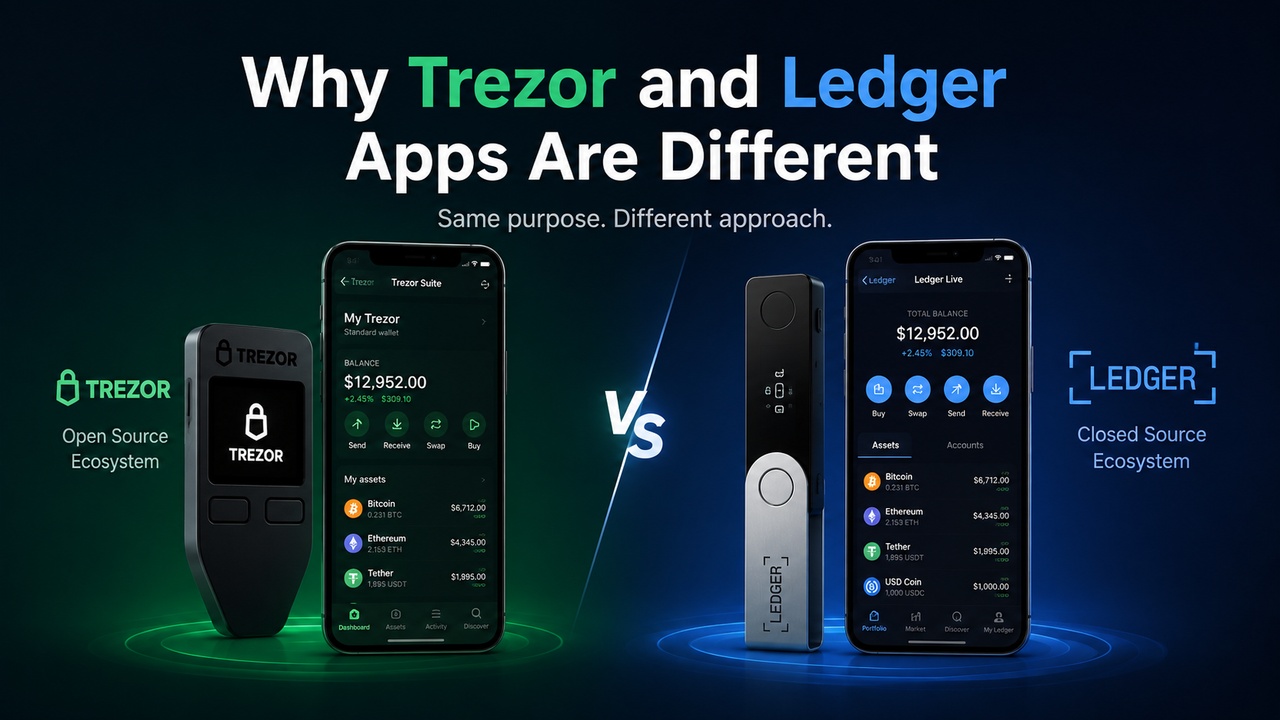
Many newcomers to cryptocurrency assume that all wallet apps work the same way. After all, whether it’s on a desktop computer or a mobile phone, most crypto wallets allow users to create accounts, store assets, send transactions, and manage their portfolios.
However, hardware wallet ecosystems such as Ledger and Trezor operate very differently from traditional software wallets. Understanding this distinction is important for anyone serious about crypto security.
The Traditional Hot Wallet Model
Most crypto wallets are “hot wallets,” meaning the wallet’s private keys are stored on an internet-connected device.
Examples include wallets like MetaMask, Trust Wallet, Rabby, and many others.
In this model:
- The desktop app is a complete wallet.
- The mobile app is a complete wallet.
- Users can create wallets directly inside the application.
- Private keys are generated and stored on the device.
- Transactions can be signed directly by the app.
The wallet application itself is the actual wallet.
Without any additional hardware, users can fully manage their crypto assets.
The Hardware Wallet Model
Ledger and Trezor follow a completely different security architecture.
In a hardware wallet setup:
- The hardware device is the actual wallet.
- The private keys never leave the device.
- The desktop or mobile application serves primarily as an interface.
- Transactions are signed inside the hardware wallet, not inside the app.
This means that Ledger Live and Trezor Suite are not designed to function like traditional hot wallets.
Instead, they act as management software that communicates with the hardware wallet.
Think of the App as a Remote Control
A simple analogy is to think of a hardware wallet as a secure vault.
The Ledger or Trezor device is the vault itself.
The desktop or mobile app is merely the control panel used to:
- View balances
- Generate receiving addresses
- Prepare transactions
- Install apps and firmware updates
- Manage supported blockchains
However, the app cannot access the private keys stored inside the hardware wallet.
Even if someone gains access to your computer, they still cannot directly extract the keys from the device.
Why This Design Is More Secure
The primary purpose of a hardware wallet is isolation.
Traditional hot wallets keep private keys on devices connected to the internet, making them vulnerable to:
- Malware
- Keyloggers
- Phishing attacks
- Remote exploits
Hardware wallets reduce this risk by keeping the keys inside a dedicated secure device.
When sending crypto:
- The desktop or mobile app creates a transaction.
- The transaction is sent to the hardware wallet.
- The hardware wallet displays the transaction details.
- The user confirms the transaction on the device.
- The hardware wallet signs the transaction internally.
- The signed transaction is returned to the app for broadcasting to the blockchain.
At no point do the private keys leave the device.
Why Ledger Live and Trezor Suite Feel Different
Users coming from wallets like MetaMask or Trust Wallet often find Ledger Live and Trezor Suite somewhat restrictive.
That’s because these applications were never intended to be standalone wallets.
Their main job is to provide:
- Portfolio management
- Asset monitoring
- Device configuration
- Blockchain connectivity
- Transaction preparation
The actual security-critical operations remain inside the hardware wallet.
This separation of responsibilities is intentional and is one of the main reasons hardware wallets are considered significantly safer for long-term crypto storage.
The Key Takeaway
A traditional hot wallet application is both the wallet and the interface.
A Ledger or Trezor application is primarily the interface, while the hardware device itself is the wallet.
This distinction explains why Ledger Live and Trezor Suite behave differently from most crypto wallet apps. Their purpose is not to replace the hardware wallet but to provide a secure bridge between the user and the private keys stored inside the device.
Understanding this architecture helps crypto users make better decisions about security and choose the right wallet solution for their needs.