
Why Real World Assets Need Their Own Chain
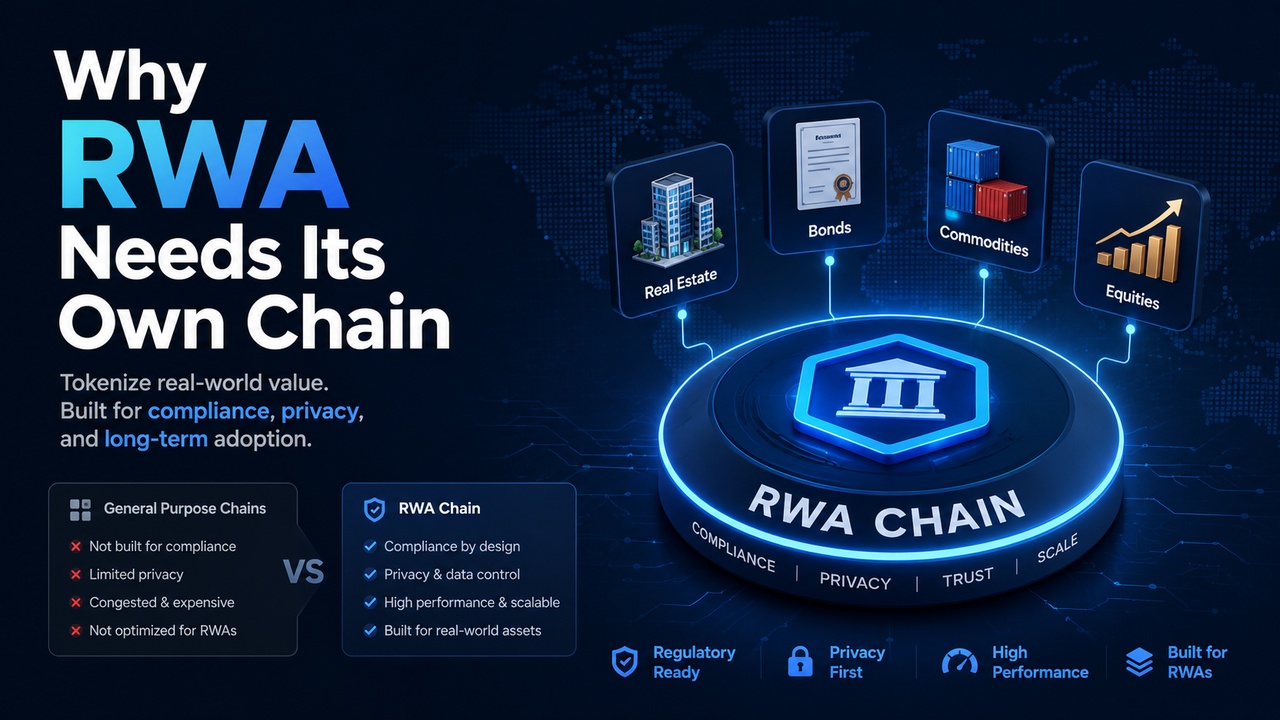
Tokenizing a real world asset is not the same as launching a memecoin. A memecoin’s worst-case failure is that a chart goes to zero and people lose money they knew was speculative. A real world asset’s worst-case failure is a disputed property title, a frozen credit line, or a commodity certificate that no court will recognize. The stakes are different, and the infrastructure needs to reflect that.
General-purpose chains were not built for this
Most Layer 1s are optimized for whatever is popular this cycle — DeFi speculation, NFT trading, gaming, memecoins. That’s a reasonable thing to optimize for if your target market is traders. It is the wrong thing to optimize for if your target market is a building, a barrel of oil, or a line of credit.
Real world assets bring requirements that general-purpose chains rarely prioritize:
Compliance is not optional. A tokenized building has a real owner, real regulators, and real legal recourse if something goes wrong. A chain built for anonymous DeFi degens has no natural place for KYC, jurisdiction-aware transfer rules, or auditable ownership history — because its users never wanted that in the first place.
Settlement finality has to be unambiguous. In DeFi, a reorg or a delayed confirmation is an inconvenience. In RWA, it’s a legal question: did the sale finalize or didn’t it? Courts and counterparties need a single, unambiguous answer, not “probably, with high confidence.”
Fees need to be predictable, not exciting. A chain with $50 gas spikes during a bull run is a fun war story for a DeFi trader. It’s a dealbreaker for a real estate settlement platform trying to model costs for a $2M transaction six months out.
The mismatch shows up in practice, not just in theory
This isn’t a hypothetical concern. RWA projects that launched on general-purpose chains have repeatedly run into the same wall: the chain’s own governance, fee market, or upgrade cadence gets reprioritized around whatever’s driving TVL that quarter — which is rarely RWA. You end up building compliance-critical infrastructure on top of a foundation that was never designed to hold it, and hoping nothing shifts underneath you.
A purpose-built chain doesn’t have that conflict. There’s no other constituency to deprioritize RWA in favor of, because RWA is the constituency.
Boring, on purpose
Ethwei is engineered from the ground up for these demands — secure, simple, and decentralized. Not flashy. Not chasing whatever narrative is trending. A chain that moves real property, real credit, and real equity should be the least interesting part of the transaction — predictable enough that nobody has to think about it, which is exactly the point.